
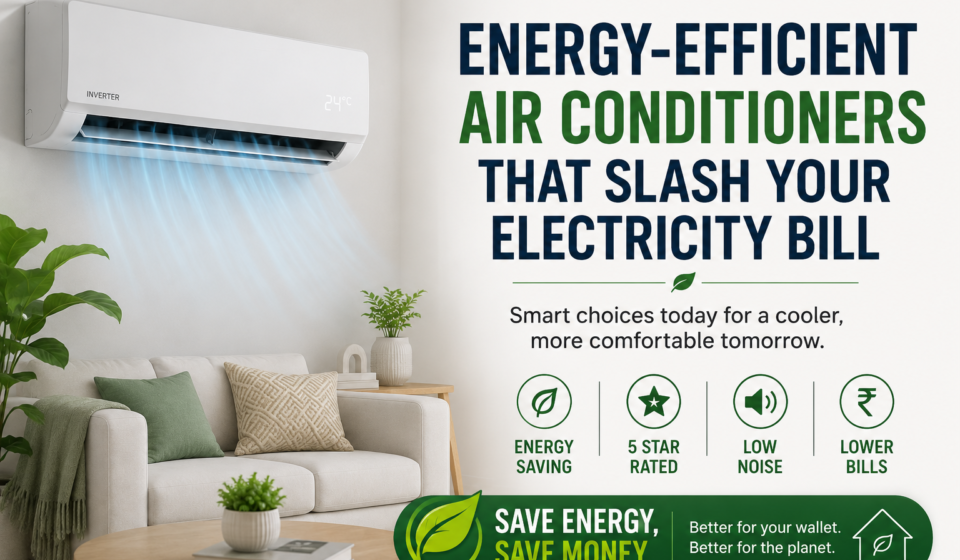

When summer temperatures in India regularly cross 40°C, an air conditioner is no longer a luxury—it’s a necessity. However, for many households, the excitement of buying a new AC quickly fades when the monthly electricity bill arrives. It’s common to see bills increase by ₹5,000–₹12,000 during peak summer (depending on your consumption), leaving families wondering whether staying comfortable is worth the cost.
The good news is that modern energy-efficient air conditioners can significantly reduce electricity consumption while providing better cooling, quieter operation, and a longer lifespan. Choosing the right model, using it correctly, and maintaining it properly can save thousands of rupees every year.
This guide explains everything Indian consumers need to know before buying an energy-efficient AC and how to maximize savings without compromising comfort.
Why Do Air Conditioners Consume So Much Electricity?
Many people assume that all air conditioners consume the same amount of electricity. In reality, power consumption depends on several factors:
- Compressor technology
- Energy efficiency rating
- Cooling capacity
- Room insulation
- Outdoor temperature
- Usage habits
- Maintenance
An older AC may consume 30% to 60% more electricity than a modern inverter model, even if both have the same cooling capacity.
The Biggest Pain Faced by Indian Consumers
Before choosing an AC, it’s important to understand the problems most homeowners experience.
1. High Electricity Bills
This is the biggest concern.
Many families hesitate to use their AC because they’re afraid of receiving huge electricity bills at the end of the month.
An inefficient AC running for 8 hours every night throughout the summer can dramatically increase monthly electricity expenses.
2. Wrong AC Size
Many buyers purchase either:
- A small AC that struggles continuously
- or an oversized AC that cycles on and off frequently.
Both situations waste electricity.
3. Poor Installation
Even an expensive 5-star inverter AC won’t perform efficiently if:
- Refrigerant piping is incorrect
- Insulation is poor
- Installation is sloppy
- Outdoor airflow is blocked
Poor installation alone can increase electricity consumption by 10–20%.
4. Fake Marketing Claims
Many advertisements promise:
- “90% electricity savings”
- “Ultra-low power consumption”
These claims are often misleading.
The actual savings depend on:
- Room size
- Outdoor temperature
- Thermostat settings
- Daily usage
What Makes an Air Conditioner Energy Efficient?
Energy-efficient ACs use advanced technologies to provide the same cooling while consuming less electricity.
The main features include:
Inverter Compressor
Unlike traditional compressors that continuously switch ON and OFF, inverter compressors automatically adjust their speed.
Benefits include:
- Lower electricity consumption
- Quieter operation
- Better temperature stability
- Longer compressor life
This technology alone can reduce power consumption by 20% to 45% under typical household usage.
Higher Star Rating
In India, air conditioners receive energy ratings from the Bureau of Energy Efficiency (BEE).
Generally:
- 3-star AC → good efficiency
- 4-star AC → better savings
- 5-star AC → maximum efficiency
Although 5-star models cost more initially, they usually recover the extra investment within a few years through lower electricity bills.
Variable Speed Operation
Instead of running at maximum capacity all the time, variable-speed compressors continuously adjust cooling according to room conditions.
This avoids unnecessary power consumption.
Smart Temperature Sensors
Modern ACs monitor:
- Indoor temperature
- Humidity
- Occupancy
This helps optimize cooling while reducing energy use.
Choosing the Right AC Capacity
Buying the wrong capacity is one of the most common mistakes.
A larger AC is not always better.
Small Bedrooms (Up to 120 sq ft)
Usually:
1 Ton
Medium Rooms (120–180 sq ft)
Usually:
1.5 Ton
Large Rooms (180–250 sq ft)
Usually:
2 Ton
Other factors also matter:
- Top-floor rooms
- West-facing walls
- Large windows
- Number of occupants
- Sunlight exposure
These may require a larger capacity.
Inverter AC vs Non-Inverter AC
Many buyers get confused.
Non-Inverter AC
The compressor:
- Turns ON
- Cools rapidly
- Turns OFF
- Room heats again
- Turns ON again
This repeated cycling wastes electricity.
Inverter AC
The compressor rarely stops.
Instead, it slows down after reaching the desired temperature.
This consumes much less electricity over long periods.
How Much Money Can You Save?
Let’s consider an example.
Suppose:
- AC runs 8 hours daily
- Summer lasts 5 months
- Electricity costs ₹8 per unit
A conventional AC may consume approximately:
1.6–2 units per hour.
A modern inverter AC may average:
0.8–1.2 units per hour.
Annual savings can easily reach:
₹3,000–₹10,000 depending on usage.
Heavy users may save even more.
Features Worth Paying For
Some features genuinely improve efficiency.
Sleep Mode
Automatically raises the temperature slightly during the night.
Benefits:
- Lower electricity use
- Better sleep
- Less compressor workload
Eco Mode
Reduces compressor output while maintaining comfortable cooling.
Ideal for:
- Nighttime
- Mild weather
- Smaller rooms
AI Cooling
Premium models learn your usage patterns.
They automatically optimize:
- Compressor speed
- Airflow
- Cooling cycles
Copper Condenser
Copper offers:
- Faster heat transfer
- Easier repairs
- Longer lifespan
- Better cooling
Most experts recommend copper over aluminium.
Features That Are Mostly Marketing
Not every feature justifies a higher price.
Examples include:
- Decorative LED displays
- Wi-Fi connectivity (if rarely used)
- Voice assistant compatibility
- Colorful indoor panels
These features improve convenience but have little effect on electricity consumption.
Tips to Reduce Your Electricity Bill Without Buying a New AC
If replacing your AC isn’t possible immediately, these habits can still reduce power consumption.
Set the Temperature Correctly
Many people choose 18°C.
This is unnecessary.
A setting between 24°C and 26°C is comfortable for most Indian households and significantly reduces electricity usage.
Keep Doors Closed
Every time warm air enters the room:
- Compressor works harder
- Cooling time increases
- Electricity consumption rises
Use Curtains
Sunlight entering through windows dramatically increases indoor temperature.
Blackout curtains or reflective blinds help reduce heat gain.
Clean Filters Every Month
Dirty filters reduce airflow.
This forces the compressor to work longer.
Cleaning filters takes only a few minutes but improves cooling efficiency considerably.
Service the AC Regularly
Professional servicing should include:
- Condenser cleaning
- Evaporator cleaning
- Refrigerant pressure check
- Electrical inspection
- Drainage cleaning
Annual maintenance keeps efficiency close to factory levels.
Ceiling Fans Can Save Electricity Too
Many people believe fans should be switched off while using the AC.
Actually, ceiling fans help distribute cool air more evenly.
This allows raising the thermostat by 2°C while maintaining comfort.
That small adjustment alone can noticeably reduce electricity consumption.
Is Solar Power a Good Option?
If your household uses the AC heavily throughout summer, rooftop solar panels can greatly reduce electricity expenses.
Benefits include:
- Lower monthly bills
- Protection against rising electricity tariffs
- Long-term savings
- Environmentally friendly operation
Although the initial investment is substantial, government subsidies in many Indian states make solar increasingly affordable.
Common Mistakes That Increase Electricity Bills
Avoid these habits:
- Running the AC with open windows
- Ignoring dirty air filters
- Delaying servicing
- Installing the outdoor unit in direct sunlight without ventilation
- Using an incorrect room size
- Frequently changing temperature settings
- Turning the AC ON and OFF every few minutes
Should You Replace an Old AC?
Consider replacement if your AC:
- Is more than 10 years old
- Requires frequent repairs
- Uses outdated refrigerants
- Produces excessive noise
- Struggles to cool
- Consumes large amounts of electricity
The energy savings alone often justify upgrading to a modern inverter model.
What Should Indian Buyers Look for Before Purchasing?
Before making your decision, compare:
- BEE Star Rating
- Annual electricity consumption
- Inverter compressor technology
- Copper condenser coil
- Warranty on the compressor
- Availability of nearby service centers
- Spare parts availability
- Customer reviews
- Noise levels
- Smart energy-saving modes
Avoid choosing solely based on the lowest price. A slightly more expensive, energy-efficient model often costs less to own over its lifetime.
Frequently Asked Questions
Which AC consumes the least electricity?
Modern inverter air conditioners with a high BEE star rating generally consume the least electricity because they adjust compressor speed instead of repeatedly turning on and off.
Is a 5-star AC worth the extra money?
If you use your AC regularly during the summer, a 5-star model can lower electricity costs enough over several years to offset its higher purchase price.
What temperature is best for saving electricity?
A setting between 24°C and 26°C provides a comfortable balance between cooling and energy efficiency for most homes.
Does turning the AC off and on repeatedly save electricity?
No. Frequent restarting forces the compressor to work harder. It’s generally more efficient to maintain a stable temperature.
How often should AC filters be cleaned?
Clean the filters every 2–4 weeks during heavy use. Regular cleaning improves airflow and helps the AC operate efficiently.
Final Thoughts
Choosing an energy-efficient air conditioner isn’t just about buying the latest model—it’s about making a smart long-term investment. For Indian households dealing with rising electricity tariffs and intense summer heat, the right AC can provide comfortable cooling while keeping monthly expenses under control.
A modern inverter AC with a high BEE star rating, correctly sized for your room and maintained regularly, can deliver substantial savings year after year. Pair it with simple habits like setting the thermostat to 24–26°C, cleaning filters regularly, blocking direct sunlight, and using ceiling fans to circulate cool air. These small changes can significantly reduce power consumption without sacrificing comfort.
Instead of focusing only on the purchase price, consider the total cost of ownership, including electricity usage, maintenance, reliability, and service support. Spending a little more on an efficient model today can save you thousands of rupees over the life of the appliance. In the long run, an energy-efficient air conditioner is not just better for your wallet—it also reduces energy demand and contributes to a more sustainable future.


Great content! Keep up the good work!