
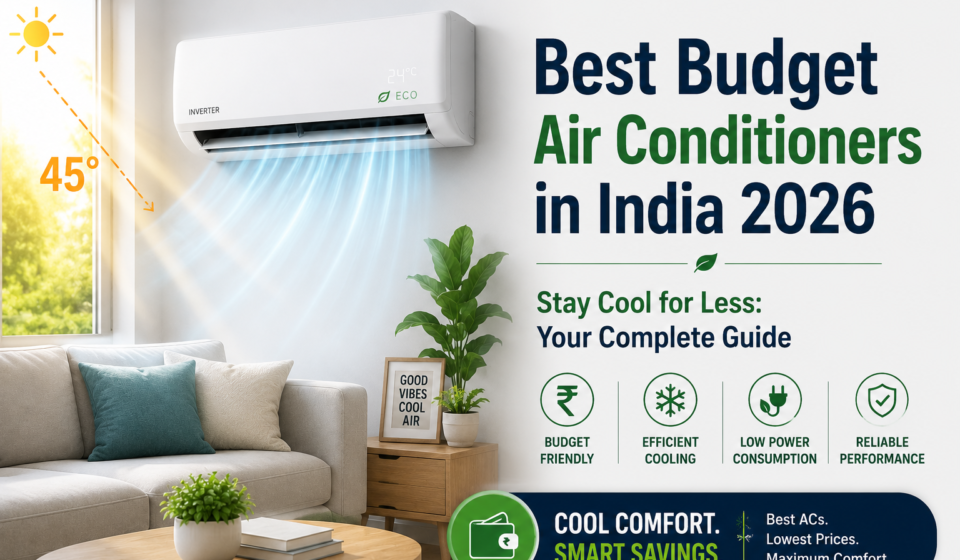

If you are planning to buy an air conditioner in India, choosing the right one is about much more than finding the lowest price. A budget AC should cool your room properly, keep electricity bills under control, and stay reliable during the hottest months of the year.
That balance matters because many buyers save money upfront but end up paying more later through higher power use, poor cooling, or costly maintenance. This guide will help you choose a budget-friendly split AC that gives real value, not just a low sticker price.
What makes a good budget AC
A good budget AC is one that fits your room, your usage pattern, and your monthly budget. The right choice depends on how often you use it, how large your room is, and how much you care about electricity savings.
The cheapest model is not always the best deal. Sometimes a slightly more expensive AC pays for itself over time because it cools more efficiently and uses less power.
For most Indian buyers, a strong budget split AC should offer:
- Proper cooling according to your room size.
- Reasonable electricity consumption.
- Decent build quality.
- Good after-sales support.
- A fair warranty.
- Value for money.
Here are the top 4 high-quality Split ACs in your budget, and 2 low-budget ACs
If your priority is maximum value for money (not just the lowest price), these are some of the best budget air conditioners available in India in 2026. I prioritized cooling performance, reliability, after-sales service, energy efficiency, and overall value.
Quick Table
| Brand | Best For | Typical Price Range |
|---|---|---|
| 👉 Blue Star | ✅ Best overall budget | ₹32,000–38,000 |
| 👉 Daikin | ✅ Excellent reliability | ₹36,000–39,000 |
| 👉 Godrej | ✅ Features at a lower price | ₹30,000–33,000 |
| 👉 Hitachi | ✅ Powerful cooling | ₹33,000–36,000 |
| 👉 Cruise | ✅ Lowest budget inverter | ₹26,000–30,000 |
| 👉 Kelvinator | ✅ Small rooms | ₹23,000–27,000 |
- Prices vary by retailer, offers, and installation packages.
Best Overall Budget AC
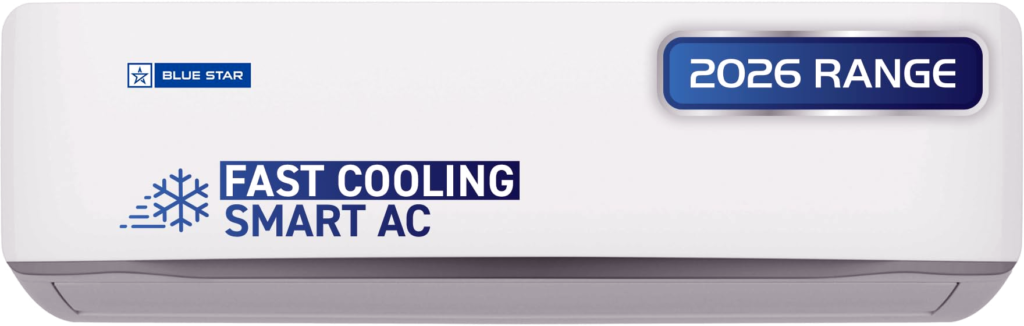
Blue Star 1 Ton 5-Star, Smart Inverter Split AC
Convertible 5 in 1 Cooling – DigiQ Hepta Sensor – Blue Fins – Self Diagnosis
Why it’s a great choice
- ✅ Excellent value for money
- ✅ 5-in-1 convertible cooling
- ✅ Inverter compressor
- ✅ Copper condenser
- ✅ Stabilizer-Free Operation
- ✅ Self-Diagnosis Feature
- ✅ Voice Control
- ✅ Wi-Fi Enabled
- ✅ Purifies Air
- ✅ Perfect for Monsoon Season
- ✅ Good Nationwide Service Network
- ✅ Suitable for Extreme Indian Summers
- ✅ Cools like a 1.5-ton AC
💎 Ideal for rooms of 120–180 sq. ft.
⭐ Wi-Fi Enabled – Voice Controlled
💚 Price: ₹37,490

The Blue Star 2026 Series AC offers an excellent balance of affordability, cooling performance, and energy efficiency. Its 5-in-1 convertible inverter technology adjusts cooling based on your needs, helping reduce electricity bills while ensuring reliable performance even during India’s intense summer heat.
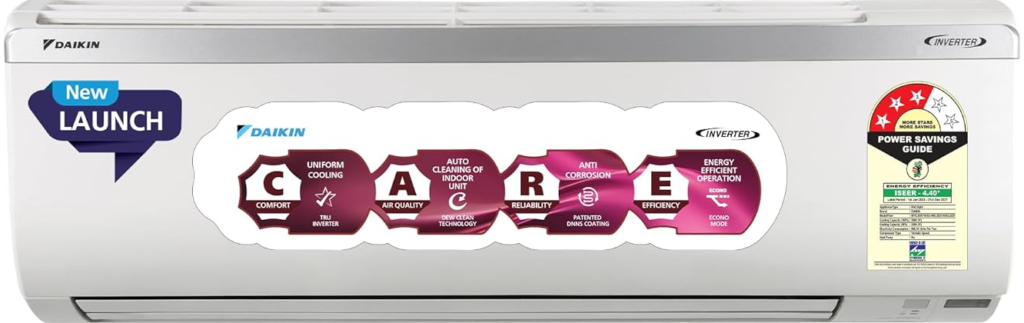
Daikin 1.5 Ton 3 Star, Inverter Split AC with PM2.5 Filter
Why choose this AC:
- ✅ Powerful Inverter Compressor
- ✅ Dew Clean Technology
- ✅ PM2.5 Air Filter
- ✅ Triple Display
- ✅ 100% Copper Coil
- ✅ Stabilizer Inside
- ✅ Anti-corrosion Treatment
- ✅ Quiet Operation
- ✅ Excellent Cooling Performance
- ✅ Low Maintenance Cost
⭐ Best for Long-Term Reliability
💎 Filter Clean Indicator
💚 Price: ₹37,490
Perfect for smaller rooms, the Daikin 1.5 Ton Inverter AC delivers efficient cooling, low noise levels, and dependable performance. The advanced inverter compressor adjusts power according to cooling demand, helping you stay comfortable while reducing energy consumption.
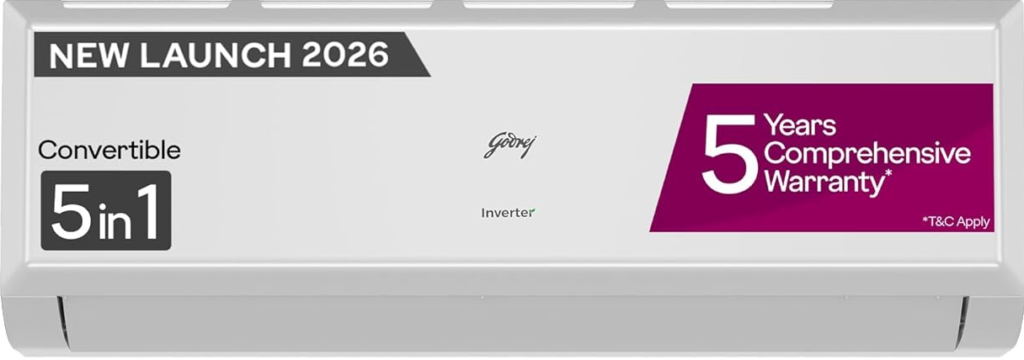
Godrej 1.5 Ton 5-in-1 Convertible Inverter AC
Why choose this AC:
- ✅ 5-in-1 Convertible Cooling
- ✅ I-Sense Technology
- ✅ AI Powered
- ✅ Heavy Duty Cooling up to 52°C
- ✅ Anti-Dust Filter
- ✅ Self-Cleaning Technology
- ✅ Copper Condenser
- ✅ Anti-Corrosion Blue Fin Coating
- ✅ Eco Mode
- ✅ Smart Diagnosis
⭐ Best Feature-Rich Budget AC
💎 Powered by AI
💚 Price: ₹31,950
The Godrej Convertible Inverter AC 2026 version combines affordability with advanced cooling features. Its 5-in-1 convertible mode adapts to varying weather conditions, delivering efficient cooling while minimizing electricity consumption. It’s a great choice for buyers seeking premium features without a premium price.
Types of air conditioners
Before you compare brands, it helps to understand the main AC types available in the budget segment.
Split AC
A split AC has two parts: an indoor unit and an outdoor unit. It is popular because it usually looks better, runs quieter, and cools bedrooms and living rooms efficiently.
Split ACs are a good choice if you want:
- Better comfort.
- Lower noise.
- More modern design.
- Regular daily use.
The main drawback is that installation can cost extra, and the upfront price is often higher than a window AC.
Window AC
A window AC is usually more affordable and simpler to install if your room setup supports it. It is often a practical choice for buyers who want strong cooling on a tighter budget.
Window ACs are useful when:
- You want lower upfront cost.
- You have a suitable window space.
- You do not want a complicated installation.
- You need a simple, functional cooling solution.
The downside is that window ACs can be noisier and bulkier than split models.
Inverter AC
An inverter AC adjusts its compressor speed based on the room’s cooling need. Instead of constantly switching on and off, it runs more smoothly and often saves power over time.
Inverter ACs are a smart option if:
- You use the AC for many hours.
- You want better energy efficiency.
- You care about stable cooling.
- You want lower electricity bills in the long run.
For many buyers, inverter ACs are worth the extra cost because they are more efficient during regular use.
How to choose the right AC
The best budget AC is not the same for every home. You should choose based on room size, electricity use, and service support.
Room size and ton capacity
Capacity matters a lot. A small room may work well with 1 ton, while a medium-sized room may need 1.5 ton. If the AC is too small, it will struggle to cool the room and may consume more power trying to do the job.
A simple way to think about it:
- Small room: usually 1 ton.
- Medium room: usually 1.5 ton.
- Larger room: may need higher capacity.
If your room gets strong afternoon sunlight or has poor insulation, you may need slightly more capacity than expected.
Energy efficiency and star rating
Energy efficiency is one of the most important things to check. A better star rating usually means lower electricity use, which becomes very important if you use the AC daily.
For budget buyers, a slightly more efficient AC may cost more initially but can save money every month. Over a few summers, that difference can become meaningful.
Noise level
Noise is easy to ignore when buying, but it matters a lot in daily use. If you plan to use the AC in a bedroom, a quieter model can improve sleep and comfort.
Split ACs are usually quieter than window ACs, which is one reason many buyers prefer them.
Brand service and warranty
A good brand is not just about cooling performance. It is also about whether you can get help quickly if something goes wrong.
Before buying, check:
- Service availability in your city.
- Compressor warranty.
- Spare part support.
- Installation support.
A low-priced AC from a weak service network can become expensive later if repairs take too long or cost too much.
Installation and maintenance cost
Many people forget to include extra costs. Installation, brackets, piping, electrical work, and yearly servicing all affect the true cost of ownership.
You should always compare the total cost, not just the product price. A slightly higher-priced AC with better build quality may be more economical in the long run.
Best AC categories for budget buyers
Instead of searching for one perfect model, think in terms of use case.
Best AC for small rooms
If your room is compact, a properly sized 1-ton AC is often enough. You do not need to overspend on more capacity than your room requires.
This is a good category for:
- Bedrooms.
- Study rooms.
- Guest rooms.
- Small apartments.
Best AC for medium rooms
For medium rooms, a 1.5-ton AC is often the safer choice. It can cool more comfortably without overworking the unit.
This category works well for:
- Master bedrooms.
- Bigger bedrooms.
- Smaller living rooms.
Best AC for tight budgets
If your budget is very limited, a window AC may give you the lowest starting cost. It can be a practical option if your room layout supports installation and you want straightforward cooling.
This is the right category if:
- You want minimum upfront spending.
- You do not mind extra noise.
- You want simple functionality.
Best long-term value AC
If you want the best value over several years, an inverter split AC is often the strongest option. It may cost more at the beginning, but it usually offers better power savings and more stable cooling.
This is ideal for buyers who:
- Use the AC often.
- Want lower bills.
- Prefer comfort and quiet operation.
Features worth paying for
Some features actually improve value and comfort. These are the ones worth paying extra for.
- Inverter compressor.
- Copper condenser.
- Good energy rating.
- Sleep mode.
- Fast cooling.
- Auto-clean function.
- Stable performance in high heat.
- Reliable warranty.
Copper condensers are often preferred because they are generally easier to maintain and can be more durable in many conditions.
Features you can skip
Not every extra feature is worth the extra money. Some features look attractive in ads but do not change your day-to-day comfort much.
You can often skip:
- Fancy app controls if you will never use them.
- Overly complex smart features.
- Decorative design upgrades that increase price.
- Extra modes with little real-world value.
Focus your money on cooling efficiency, reliability, and service support instead.
Common mistakes buyers make
A lot of buyers make the same avoidable mistakes when shopping for a budget AC.
- Buying the wrong tonnage for the room.
- Choosing only by price.
- Ignoring electricity use.
- Forgetting installation costs.
- Skipping warranty checks.
- Not checking service support in their city.
These mistakes can turn a “cheap” AC into an expensive one over time.
How to save money on an AC
You can reduce both the purchase cost and the running cost with a few smart habits.
- Buy during seasonal sales.
- Compare prices across multiple sellers.
- Use curtains to block direct sunlight.
- Keep doors and windows closed while cooling.
- Clean filters regularly.
- Set the temperature sensibly instead of overcooling.
- Use ceiling fans to support cooling.
Small habits like these can make a noticeable difference in power use.
AC Types comparison table
| AC type | Best for | Upfront cost | Noise level | Energy savings | Ideal room size |
|---|---|---|---|---|---|
| Window AC | Tight budgets | Low | Medium to high | Moderate | Small to medium rooms |
| Split AC | Everyday comfort | Medium | Low | Moderate to high | Small to medium rooms |
| Inverter split AC | Long-term savings | Medium to high | Low | High | Small to medium rooms |
This table gives you a simple way to compare the main options before narrowing down specific models.
FAQs
Which AC is best for a small room?
A 1-ton AC is often enough for a small room, especially if the space is well insulated and not exposed to strong direct sunlight.
Is inverter AC worth it for budget buyers?
Yes, if you use the AC often. It usually costs more at first but can save money on electricity over time.
How do I know what tonnage I need?
Start with your room size. Smaller rooms usually need 1 ton, while medium rooms often need 1.5 ton. Heat, sunlight, and insulation also matter.
Is window AC still a good choice in 2026?
Yes, especially if your priority is low upfront cost and your room setup supports it.
How can I reduce my AC bill?
Choose the right size, use an efficient model, clean filters regularly, and avoid overcooling the room.
Final buying advice
If you want the best budget air conditioner in India, focus on value, not just the lowest price. A properly sized, energy-efficient AC with reliable service support will usually give you a much better experience than the cheapest model on the shelf.
For most buyers, the safest choice is a well-sized inverter split AC. If your budget is very tight, a good window AC can still be a practical solution. The right answer depends on your room, your usage, and how long you plan to keep the AC.


This is really helpful when choosing an ac. Now I can make an informed decision. Thanks for everything.